
Slow Start
When the weather begins to warm up, the first instinct most homeowners have is simple, get the mower out without hesitation. But here’s the truth, starting too early can actually set your lawn back for the entire season. At Go Green Customized Lawn Care, we see it every year across York County. Lawns that are rushed in early spring often struggle later with thin spots, weeds, and weak root systems. Spring isn’t about speed, it’s about timing and biology.
What’s Really Happening Below the Surface?
Even when the grass blades start turning green, the real action is happening underground. During early spring, roots are rebuilding energy reserves, soil temperatures are gradually increasing, soil biology is getting re-acclimated, and turf is transitioning out of winter dormancy. Bottom line the plant is waking up, but it’s not fully active yet. When you mow too early or too aggressively, you force the plant to redirect energy toward blade recovery instead of root development. Reducing that stress factor controls a tradeoff from manicured lawn mentality to a shaggy look that matters.
Why Letting Your Lawn Come In Shaggy Helps
Especially with cool season lawns common here in York County, allowing grass to grow in slightly taller early on provides several advantages. It encourages deeper root development, protects the crown of the plant from the stressors of weather transitioning and heavy winds, encourages healthy growth, improves natural weed resistance, builds turf density before peak growth begins. This process allows the leaf blade to be a larger solar panel, creating and directing more healthy energy to the root systems. A slightly shaggy lawn in early spring is not neglect, it’s a requirement to prepare a lawn for as many healthy growing days as possible.
 The Problem With “Perfect” Too Early
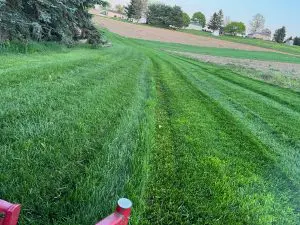 The Problem With “Perfect” Too Early
Social media and neighborhood competition push the idea that your lawn should look perfectly manicured the moment things turn green even before ground temperatures maintain 55°. But here’s the biological reality: Aggressive Early mowing + immature root systems = massive stress. Stressed turf can be weak and vulnerable turf. We often get calls in late April and May about, thin areas, early weed pressure, patchy growth, and weak color response, all of which can be drastically reduced or eliminated. In many cases, the lawn was simply pushed too hard too soon.
What a Proper Spring Wake-Up Looks Like
A healthy early spring strategy includes, allowing grass to reach a fuller / shaggy height before first cut. Its a must to avoid mowing less than 4″ and definitely avoid scalping those areas that have tuff transitions or low spots. Slow roll the heavy foot or equipment traffic if possible. Utilize soil conditioners and organic blend slow release fertilizers to help flocculate soils and reduce aggressive growth spurts. It is most important to support root development before chasing top growth or that manicured look we all love. Healthy lawns are built from the soil up with healthy robust root systems, not from aggressive mowing patterns.
Slow Wake-Up. Strong Season
The strongest lawns we maintain aren’t the ones that are mowed first! They’re the ones that start slowly and correctly. When turf wakes up gradually, the root systems have more mass to support a thicker lush turf on the surface. The lawn density improves which helps reduce the weed pressure naturally. A larger root mass develops to feed the grass a wider variety of nu trients along with a more resourceful root system to gather below grade moisture. Summer stress tolerance drastically increases. Fall recovery accelerates after a stressful summer drought. Spring doesn’t need to be a race to mow first. This is the time of year to build the foundation for a successful growing season.
York County Lawns Require Patience
Clay-heavy soils in our area warm slowly and compact easily. That makes timing even more important. Rushing the process in our region can create more long-term problems than homeowners realize. A controlled, strategic spring wake-up sets the tone for everything that follows. Allowing the lawn to have a slow start will save you time and money by reducing a strategical stress factor and allowing the plant to build its health and defense system naturally.
Final Thought
If your lawn looks a little shaggy early in the season, that is a good sign. By allowing the grass to be shaggy between the first several mows will give the entire system a slow wake up before it is ramped up to weekly mowing’s and warm weather activities. This slow wake up will develop a stronger soil structure for the grass to thrive in and for you to enjoy. The strongest lawns in our communities are not forced into spring, they slowly grow into it!